


You open the boiler cupboard and find a puddle on the floor, or a steady drip from underneath the casing. Don’t panic, but don’t ignore it. Most boiler leaks come from a worn seal or valve, a pressure relief valve letting water past, or corrosion on a pipe joint. Turn the boiler off, catch the water, keep electrics dry and get in touch to book a boiler repair. We cover homes across Sutton and nearby areas including
.
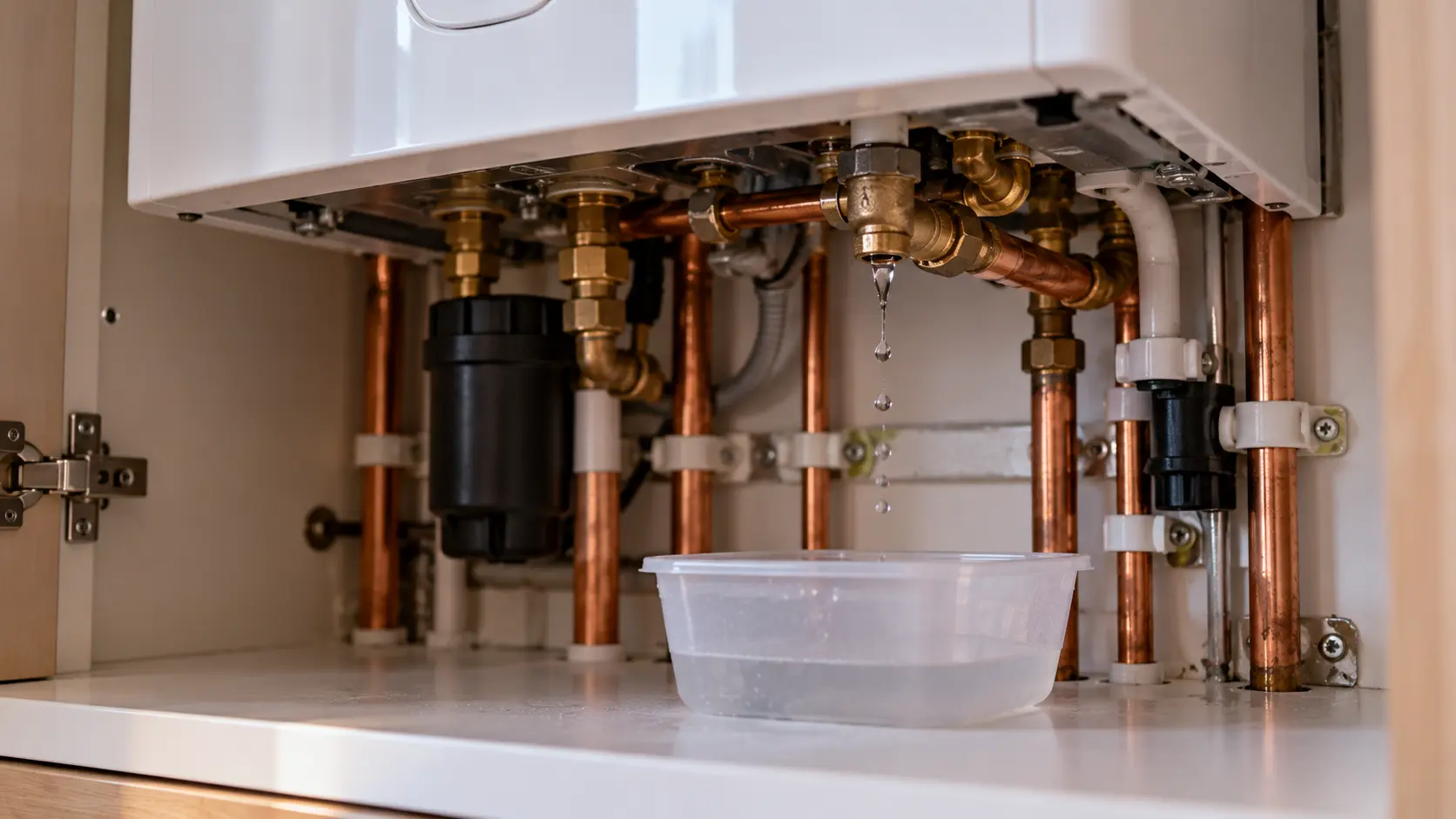
What to do straight away
- Turn the boiler off at the controls and switch off the fused spur if water is near any electrics.
- Catch the water with a bowl or towels and move anything valuable out of the way.
- Check the pressure gauge. If it has dropped, the leak is likely from the sealed heating system.
- Look, don’t touch. Note where the water seems to come from, but never remove the boiler casing.
- Turn off the water at the stopcock if the leak is heavy and you can’t contain it.
If you smell gas at any point, leave the boiler alone, turn off the gas at the meter if it’s safe to do so, open windows and call the National Gas Emergency Service on 0800 111 999.
The most common causes
A worn seal or internal joint
Boilers contain plenty of rubber seals and O-rings around the pump, valves and heat exchanger. Over time they harden and start to weep. These leaks often show as a slow drip from the bottom of the casing.
The pressure relief valve
If the system pressure climbs too high, the pressure relief valve opens to release water, usually through a copper pipe running to an outside wall. A dripping pipe outside, or water marks below it, often means the valve is worn or the pressure is rising too far.
A faulty expansion vessel
When the expansion vessel loses its air charge, pressure swings much higher as the water heats. That pushes water out through the relief valve and then leaves the pressure low once the system cools. If your gauge rises sharply with the heating on, this is a likely cause.
Corrosion
Pipes, fittings and the heat exchanger itself can corrode, especially in older boilers or systems with dirty water. Rust stains or green crusting around joints are tell-tale signs. A corroded heat exchanger on an older boiler can be costly to replace.
The condensate pipe
Condensing boilers drain slightly acidic water through a plastic pipe. A loose joint or blockage in that pipe can cause drips under the boiler, often worse when the heating is working hard.
Is a leaking boiler dangerous?
Water and electrics don’t mix, which is why turning the boiler off and keeping the area dry is the first step. A leak can also damage floors and ceilings, and if it’s coming from the sealed system the boiler will lose pressure and eventually lock out.
A water leak is not the same as a gas leak, but any repair inside the casing is work for a Gas Safe registered engineer.
Repair or replace?
A seal, valve or relief valve is usually a straightforward repair. A leaking heat exchanger on an older boiler is a bigger decision, as the part can be expensive and other components may be near the end of their life too.
Many homes around Sutton, Cheam and Wallington have boilers that have been working hard for well over a decade. If yours is leaking and has a history of faults, it’s worth asking the engineer whether repair still makes sense, or whether a new boiler would be the better long-term choice.
Frequently asked questions
Can I still use my boiler if it’s leaking?
It’s best not to. Turn it off until an engineer has looked at it, especially if water is near electrical parts. If you need heat in the meantime, use portable electric heaters and keep the leak contained with towels or a bowl.
Why does my boiler only leak when the heating is on?
Leaks that appear with the heating on are often linked to pressure rising as the water heats up. A faulty expansion vessel or pressure relief valve is a common cause, along with joints that open slightly as they expand with heat.
Will my home insurance cover a leaking boiler?
Some policies cover damage caused by escaping water, but not always the repair to the boiler itself. Check your policy, and if the boiler is under warranty, contact the manufacturer or your installer, as long as the servicing is up to date.
Found water under your boiler?
If your boiler is dripping or you’ve found a puddle in the cupboard, get in touch and we’ll send an engineer to find the leak and fix it properly.